How to Track Action Items: The Complete Guide to Ensuring Follow-Through
•
5
MIN READ
AI Summary by Fellow
Every meeting generates commitments. The problem? Most of them disappear before anyone follows through.
When action items live in scattered notes, forgotten email threads, and half-remembered conversations, accountability crumbles. Deadlines slip. Projects stall. And the time your team spent in that meeting? Wasted.
An action item is a specific task assigned to a person with a clear deadline—the building block of meeting follow-through. But writing down action items is only half the battle. The real challenge is tracking them across dozens of meetings, multiple projects, and competing priorities.
If you're still manually copying action items from meeting notes into spreadsheets or task lists, you're fighting a losing battle. Modern teams use AI meeting assistants to automatically capture, track, and follow up on action items—so nothing falls through the cracks.
Already drowning in untracked action items? See how Fellow captures them automatically.
Why do action items get lost?
Action items fail for predictable reasons, and most come down to manual processes that can't scale.
The typical workflow looks like this: Someone takes notes during a meeting (while trying to participate). After the meeting, they manually transcribe action items into a project management tool. Days later, no one remembers to check on progress. By the next meeting, half the items have been forgotten entirely.
Research backs this up. Studies show that 44% of action items from meetings never get completed, and 71% of meetings fail to achieve their objectives because of poor follow-through.
The root causes include vague task descriptions that leave people confused about expectations, missing deadlines that remove urgency, unclear ownership where multiple people assume someone else will handle it, and no follow-up system to surface incomplete items before they're forgotten.
The solution isn't working harder at manual tracking—it's using tools that automate the capture-to-completion workflow entirely.
What makes an effective action item?
An effective action item contains four essential components that eliminate ambiguity and drive completion.
1. A clear task description starting with a verb
Vague action items are productivity killers. Instead of "Website updates," write "Publish the revised pricing page with new enterprise tier by Friday."
Strong action items start with action verbs: create, send, review, schedule, complete, update, analyze. The description should include enough context that the assignee knows exactly what success looks like—without needing to ask clarifying questions.
2. An assigned owner
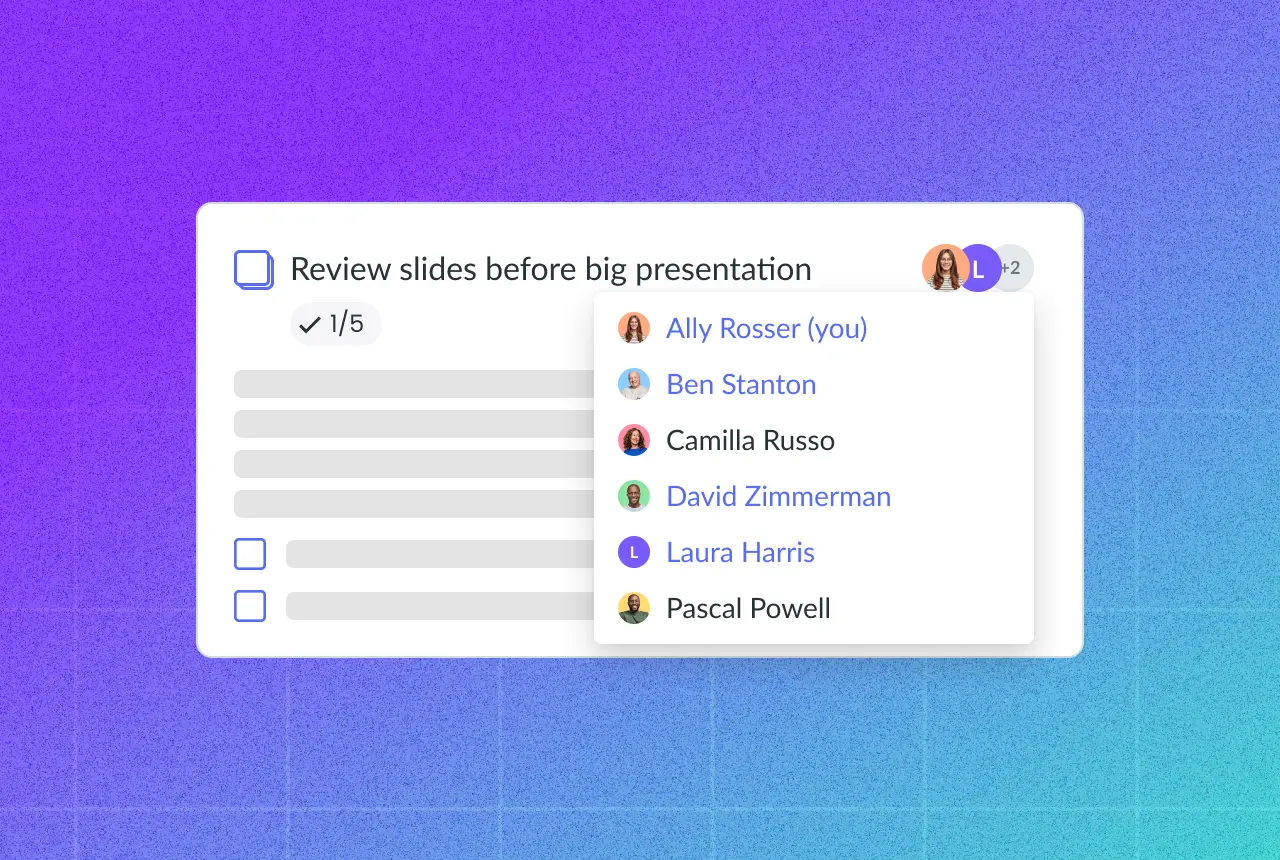
Every action item needs a single person accountable for its completion. When multiple people are "responsible," no one is.
For collaborative tasks involving multiple contributors, designate one person as the lead coordinator who's ultimately accountable for ensuring the work gets done. This person can delegate subtasks but owns the outcome.
3. A realistic due date
Action items without deadlines are just suggestions. But the deadline needs to work for both the project timeline and the assignee's capacity.
Before assigning a deadline, confirm the assignee has bandwidth to complete the task. As Paul Axtell writes in Harvard Business Review: "Don't automatically default to your next meeting date as the completion date. Choose a date that makes sense and creates urgency."
4. Priority level
When everything is urgent, nothing is. Establishing clear priority helps assignees sequence their work appropriately.
High-priority items may require deprioritizing other work. Low-priority items can be scheduled around existing commitments. Without this signal, assignees either treat everything as equally urgent (leading to burnout) or equally unimportant (leading to missed deadlines).
How to track action items effectively
The best action item tracking system requires minimal manual effort while providing maximum visibility into what's outstanding, what's at risk, and what's been completed.
Capture action items during the meeting
The moment someone commits to a task in a meeting, that action item should be documented—not scribbled on a notepad to be transcribed later.
Traditional advice suggests appointing a dedicated note-taker. The modern approach: use an AI meeting assistant that automatically captures action items as they come up in conversation, complete with the owner's name and any mentioned deadlines. This frees everyone to participate fully instead of splitting attention between engaging and documenting.
Centralize action items in one system
Action items scattered across meeting notes, emails, Slack messages, and personal to-do lists will inevitably fall through the cracks.
Choose a single source of truth where all action items live. Modern AI meeting notes tools sync directly with project management platforms like Asana, Jira, Monday, Linear, and ClickUp—so action items flow automatically from meeting capture to task execution without manual re-entry.
Build follow-up into your workflow
Action items need a follow-up system, or they'll quietly die. Your team needs clear answers to these questions: When will we review progress? How will we surface items at risk? What happens when deadlines slip?
For recurring meetings, carry forward incomplete action items to the next agenda automatically. This creates a natural accountability loop where nothing can be forgotten—the item reappears until it's marked complete.
If chasing down action items across multiple tools sounds familiar, Fellow was built specifically to solve this.
How AI transforms action item tracking
Manual action item tracking worked when teams had fewer meetings and simpler workflows. In 2026, the average professional attends 25+ meetings per week across Zoom, Google Meet, Teams, in-person sessions, and Slack huddles. Manual tracking simply can't scale.
AI meeting assistants like Fellow transform the workflow in three critical ways:
Automatic capture across all meeting types
Fellow records and transcribes meetings across every platform—Zoom, Google Meet, Microsoft Teams, in-person meetings, and Slack huddles—with or without a visible bot. The AI identifies action items from conversation context, extracts the owner and deadline when mentioned, and compiles everything into a searchable recording library.
No more furiously typing during meetings or reconstructing action items from memory afterward.
Natural language search across your meeting history
When you need to find what was committed in a specific conversation, Ask Fellow lets you query your entire meeting history with natural language questions like:
"What action items were assigned in yesterday's sprint planning?"
"What did Sarah commit to delivering for the Q2 launch?"
"What items are overdue from last week's client calls?"
This organization-wide intelligence replaces the manual work of searching through notes, transcripts, and recordings to surface specific commitments.
Direct integration with your workflow tools
Fellow connects meeting intelligence directly to 50+ native integrations plus 8,000+ apps via Zapier and n8n. Action items captured in meetings automatically sync to your existing project management system—Asana, Jira, Monday, Linear, Salesforce, HubSpot—with bi-directional updates.
Mark an item complete in your task list, and it updates in Fellow. Complete it in Fellow, and it syncs back. No manual data entry, no items lost between systems.
What to look for in an action item tracking tool
Not all meeting tools handle action items equally. When evaluating options, prioritize these capabilities:
Capability | Why it matters |
|---|---|
AI action item extraction | Automatically identifies commitments from conversation—no manual tagging required |
Multi-platform capture | Works across Zoom, Meet, Teams, in-person, and Slack without fragmented workflows |
Direct project management sync | Action items flow to existing tools (Asana, Jira, etc.) without copy-paste |
Natural language search | Find specific commitments by asking questions, not hunting through transcripts |
Automatic follow-up | Surfaces incomplete items in future meetings so nothing gets forgotten |
Enterprise security | SOC 2 Type II, HIPAA, and GDPR compliance for sensitive meeting content |
Fellow is the secure AI meeting assistant that checks every box. Built for enterprise trust with SOC 2 Type II certification, HIPAA and GDPR compliance, and a commitment to never train AI models on customer data—teams at Shopify, HubSpot, Vidyard, and Motive rely on Fellow to capture every action item while maintaining privacy controls aligned to organizational roles.
Action item examples by role
Clear action items look different depending on context. Here are examples of well-written action items across common scenarios:
Marketing team example
Meeting context: The marketing team and project manager review client feedback on an email campaign draft.
Action item: Revise email template copy incorporating client feedback on headline and CTA placement
Owner: Content writer
Due date: Friday, January 24
Priority: High
Engineering team example
Meeting context: Sprint planning identifies a blocker affecting the Q1 release timeline.
Action item: Investigate API timeout issues in staging environment and document root cause
Owner: Senior backend engineer
Due date: Wednesday, January 22
Priority: Critical
Sales team example
Meeting context: Account review reveals stalled deals requiring executive follow-up.
Action item: Send re-engagement email to VP of Engineering at Acme Corp with updated ROI projections
Owner: Account executive
Due date: Monday, January 20
Priority: High
Frequently asked questions
What is an action item?
An action item is a specific task or responsibility assigned to a person with a clear deadline, typically generated during meetings, project planning, or collaborative discussions. Effective action items include four components: a clear description starting with a verb, an assigned owner, a realistic due date, and a priority level. Unlike general to-do items, action items are commitments made in a shared context—which is why tracking them properly requires visibility across the team, not just individual task lists.
How do I track action items from meetings automatically?
Use an AI meeting assistant that captures action items during conversation and syncs them to your project management tools. Fellow, for example, automatically identifies commitments from meeting transcripts, extracts owners and deadlines, and syncs action items directly to Asana, Jira, Monday, Linear, ClickUp, Salesforce, HubSpot, and 50+ other integrations. This eliminates manual note-taking and ensures every commitment makes it from discussion to execution.
What's the best way to follow up on action items?
Build follow-up directly into your meeting workflow. Carry incomplete action items forward to the next meeting agenda automatically, so outstanding tasks surface for discussion. AI meeting assistants like Fellow do this automatically—pre-meeting briefs remind attendees of previous commitments, and you can Ask Fellow questions like "What action items are overdue from last week?" to surface items at risk before they become problems.
Can multiple people be assigned to one action item?
Yes, but designate one person as the accountable owner. Collaborative tasks often involve multiple contributors, but shared responsibility frequently becomes no responsibility. The owner can delegate subtasks and coordinate work, but one person should be accountable for the outcome. Fellow supports multiple assignees on action items while maintaining clear ownership visibility.
How do I prioritize action items effectively?
Establish priority during the meeting when context is fresh. Use a simple framework: critical (blocking other work), high (important deadline), medium (standard priority), or low (when time permits). Communicate priority alongside the action item so assignees can sequence their work appropriately. AI-powered action item tracking makes priorities visible across the team, so everyone knows what matters most.
Is action item tracking secure for enterprise teams?
Enterprise-grade action item tracking should include SOC 2 Type II certification, HIPAA and GDPR compliance, and permission-based access controls. Fellow is built for enterprise trust—your meeting content and action items are protected by industry-standard security, and Fellow never trains AI models on customer data. Organizations can maintain centralized visibility into action items while ensuring sensitive information is only accessible to authorized team members.
Stop losing action items to scattered notes
Every meeting your team holds generates commitments. The question is whether those commitments turn into completed work or disappear into the void of forgotten notes and half-remembered conversations.
Manual action item tracking worked when meetings were occasional and simple. Today's reality: dozens of meetings per week across multiple platforms, remote and hybrid teams, complex cross-functional projects demands a system that scales.
Fellow is the secure AI meeting assistant that turns every meeting into actionable intelligence. Capture action items automatically across Zoom, Meet, Teams, in-person meetings, and Slack huddles. Search your meeting history to find any commitment. Sync tasks directly to the tools your team already uses.
Join teams at Shopify, HubSpot, Vidyard, and Motive who've made action item tracking effortless.
Record, transcribe and summarize every meeting with the only AI meeting assistant built with privacy and security in mind.