The 12 Best AI Meeting Assistants for Microsoft Teams in 2026
Jan 22, 2026
•
9
MIN READ

AI Summary by Fellow
Microsoft Teams has become the central hub for enterprise communication, but meetings themselves remain a productivity black hole. Decisions get made, action items get assigned, and critical context gets shared, then it all disappears into the void of memory and scattered notes.
An AI meeting assistant solves this by automatically capturing every Teams meeting, generating structured summaries, extracting action items, and making all of it searchable across your organization. Instead of asking "What did we decide about the Q3 roadmap?" and hoping someone remembers, you can query your meeting history and get an instant answer.
For organizations running on Microsoft 365, the question isn't whether to use an AI meeting assistant. It's whether to use Microsoft's native Copilot or a specialized third-party tool that offers deeper functionality and cross-platform flexibility.
The best AI meeting assistant for Microsoft Teams combines automatic transcription with organization-wide search, enterprise-grade security, and deep integration with your existing workflow tools. For enterprise Teams environments, look for SOC 2 Type II certification, flexible recording options (with or without bots), SSO support, and native integrations beyond the Microsoft ecosystem.
Already losing critical context between meetings? Fellow is the secure AI meeting assistant that turns every conversation into searchable intelligence. Start a free 14-day trial today →
How does Microsoft Copilot handle AI meeting notes?
Microsoft Copilot provides AI meeting assistance as part of the broader Microsoft 365 suite, offering native integration with Teams, Outlook, Word, and other Microsoft apps. For organizations fully standardized on Microsoft, it can seem like a natural add-on.
Copilot strengths
Copilot works natively within the Microsoft ecosystem, providing seamless integration that third-party tools can't match for organizations fully committed to Microsoft 365.
Cross-app intelligence: Meeting content flows directly into other Microsoft apps. You can ask Copilot to draft a follow-up email in Outlook based on meeting decisions, create a Word document summarizing key points, or populate Excel with data discussed during the call. This tight integration eliminates copy-paste workflows between tools.
Microsoft Graph context: Copilot draws on Microsoft Graph data, meaning it understands your organizational context. It knows who reports to whom, which projects people are working on, and can surface relevant documents or past communications when generating meeting summaries.
Zero deployment friction: For organizations already on Microsoft 365 E3 or E5, Copilot requires no additional app installation. IT admins enable it through the existing Microsoft 365 admin center, and users access it through the Teams interface they already know.
Copilot limitations
Several factors lead organizations to choose third-party alternatives over Copilot:
Platform lock-in: Copilot only works within Microsoft Teams. Organizations that also use Zoom or Google Meet end up with fragmented meeting records and no unified search across platforms.
Limited external integrations: Copilot cannot push meeting outcomes directly into third-party tools like Salesforce, HubSpot, Jira, Asana, or Notion. This creates manual work to translate meeting decisions into actual tasks.
Cost structure: At $30 per user per month on top of existing E3/E5 licenses with no free tier, Copilot represents a significant additional investment that many organizations struggle to justify.
Privacy handling gaps: Copilot summaries don't always inherit sensitivity labels and rely heavily on tenant and user policies. There's no built-in auto-redaction or auto-delete functionality for sensitive content.
Limited admin controls: IT administrators have fewer granular meeting-level controls compared to specialized meeting platforms, making governance more challenging.
Accuracy concerns: Independent reviews have noted that Copilot summaries can miss nuanced decisions, often requiring transcript verification to ensure nothing important was lost.
Performance variability: Users report mixed results in conference room setups and with participants who have strong accents.
The 12 best AI meeting assistants for Microsoft Teams in 2026
1. Fellow
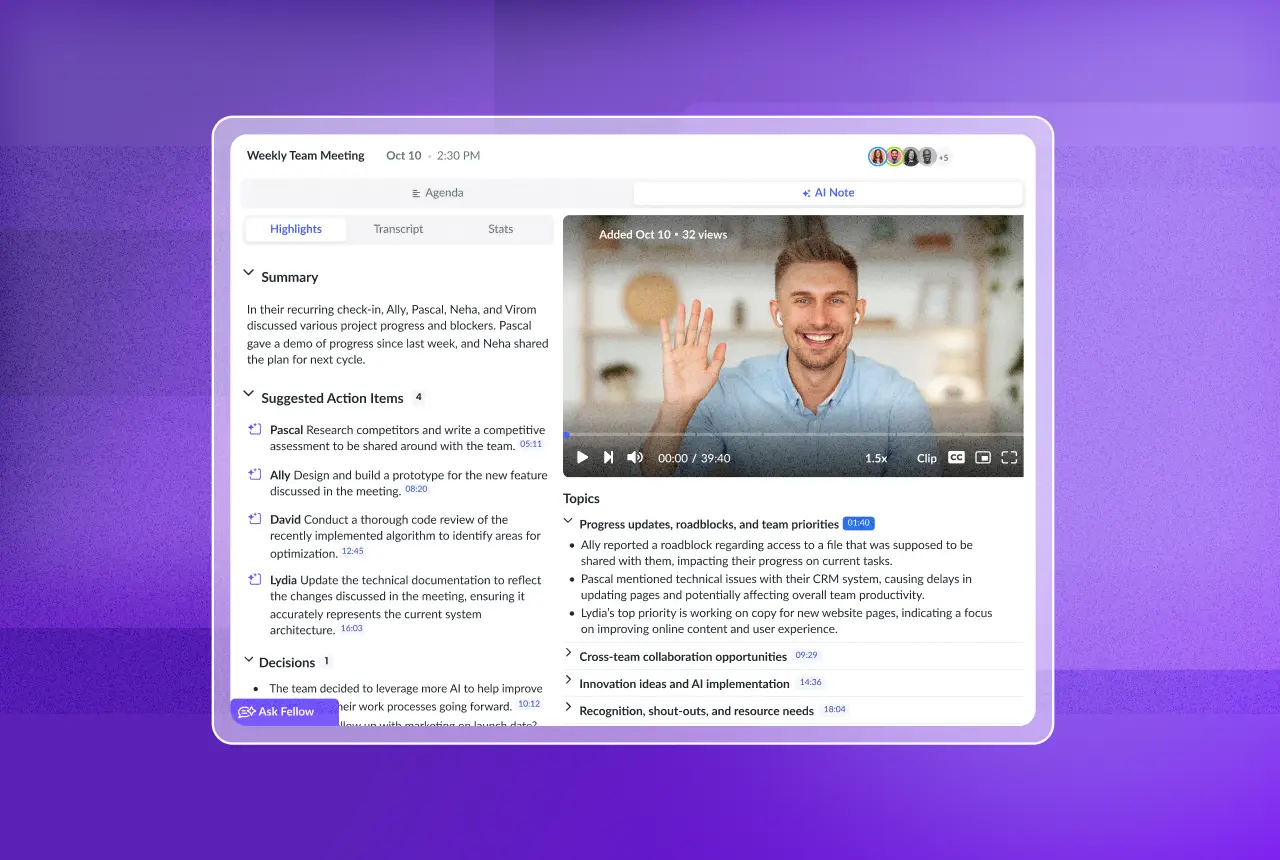
Fellow is a secure AI meeting assistant purpose-built for enterprise Teams deployments. It goes beyond transcription to deliver organization-wide meeting intelligence with the security and admin controls IT teams require.
Key strengths:
Native Microsoft Teams integration with support for Zoom, Google Meet, in-person meetings, and Slack huddles
Ask Fellow lets you query across all your meetings with natural language questions
Structured AI meeting notes that separate decisions, action items, and key discussion points
50+ native integrations plus 8,000+ apps via Zapier and n8n
Botless recording option for meetings where visible bots aren't appropriate
Transcription in 92+ languages with speaker identification
Enterprise security: SOC 2 Type II, HIPAA, GDPR compliant, no AI training on customer data
Granular privacy controls: meeting-level permissions, auto-redaction, SSO, SCIM
Best for: Enterprise organizations that need cross-platform meeting intelligence with strong security and IT governance. Trusted by teams like Shopify, HubSpot, Vidyard, and Motive.
Limitations: Feature depth may exceed needs for teams only wanting basic transcription.
2. Microsoft Copilot
Microsoft's native AI assistant integrates directly into Teams, Outlook, Word, and the broader Microsoft 365 suite.
Key strengths:
Zero additional installation for Microsoft 365 users
Real-time AI assistance during Teams meetings
Can draft documents and emails from meeting content
Covered under existing Microsoft compliance certifications
Limitations: Only works within Microsoft Teams (no Zoom or Google Meet). Limited third-party integrations. $30/user/month on top of E3/E5 licenses with no free tier. Less granular admin controls than specialized tools.
Best for: Organizations fully committed to Microsoft 365 with no cross-platform needs.
3. Otter.ai
Otter focuses on affordable, straightforward meeting transcription with real-time note-taking.
Key strengths:
Real-time transcription and searchable meeting notes
SOC 2, GDPR, and HIPAA compliant (as of mid-2025)
Competitive pricing for basic transcription needs
Limitations: Video recording only on enterprise tiers. No structured action item tracking or decision logging. Limited to three languages (English, French, Spanish). Basic admin controls. Past security concerns have been addressed but worth reviewing.
Best for: Small teams needing basic transcription without extensive workflow integration.
4. Fireflies.ai
Fireflies offers searchable transcripts with an AI assistant for querying past meetings.
Key strengths:
AskFred AI assistant for querying past calls
Audio recording via meeting bot and mobile transcription
CRM integrations on higher tiers
Topic Trackers for flagging specific keywords or phrases
Limitations: No structured pre-meeting workflows or meeting agendas. Limited real-time collaboration features. Basic task tracking. AI policy allows some training on customer data unless on enterprise agreements. Bot can auto-join meetings without explicit permission in some configurations.
Best for: Teams focused primarily on call recording and search without extensive collaboration needs.
5. Fathom
Fathom provides free unlimited recording with AI-generated summaries, positioning itself as a generous freemium option.
Key strengths:
Unlimited free recording and transcription
Clean, simple interface focused on ease of use
Automatic highlight detection for key moments
Native Teams, Zoom, and Google Meet support
Limitations: Limited integration ecosystem compared to enterprise tools. Analytics and coaching features less developed than competitors. Admin controls more basic than enterprise-grade platforms. No botless recording option.
Best for: Individual contributors and small teams who want free, straightforward meeting capture without complex setup.
6. tl;dv
tl;dv (Too Long; Didn't View) focuses on video highlights and clip sharing alongside transcription.
Key strengths:
Creates 2-minute highlight reels from hour-long meetings
Easy clip sharing with timestamp links
Multi-language support with speaker tagging
Free tier with generous limits
AI coaching features with sales framework support (BANT, MEDDICC)
Limitations: Upload functionality still in beta and inconsistent. Some accuracy issues reported with non-US accents. Missing recordings have been reported by some users. API limitations for custom integrations.
Best for: Teams that frequently share meeting clips with stakeholders who weren't present, particularly sales and customer success teams.
7. Grain
Grain specializes in video clipping, turning long meetings into shareable highlight reels.
Key strengths:
Video clipping and highlight creation
Easy sharing of specific meeting moments with stakeholders
Collaborative clip libraries for teams
Limitations: Not designed for structured action items or meeting follow-up. Limited enterprise security and admin controls. Lacks organization-wide search capabilities.
Best for: Teams that need to share specific meeting moments rather than full documentation.
8. Krisp
Krisp combines AI noise cancellation with meeting transcription, offering a bot-free approach similar to Fellow.
Key strengths:
Industry-leading AI noise cancellation removes background noise in real-time
Bot-free recording that captures audio locally
SOC 2, GDPR, HIPAA, and PCI-DSS compliant
On-device AI processing for enhanced privacy
Accent conversion feature for improved clarity
Limitations: Calendar integration can be unreliable, sometimes activating for non-meetings. Some users report missing transcriptions despite recording confirmation. Meeting history organization and search functionality is basic. Transcription accuracy varies based on microphone configuration.
Best for: Remote workers in noisy environments who need noise cancellation alongside meeting capture, with strong privacy requirements.
9. Notta
Notta offers multilingual transcription with a focus on bilingual meeting support and real-time translation.
Key strengths:
Bilingual transcription and real-time translation for international teams
SOC 2 Type II, GDPR, ISO 27001, and CCPA compliant
Notta Showcase converts videos into step-by-step guides with subtitles
Speaker labeling with high accuracy
Competitive pricing for multilingual needs
Limitations: Live transcription can lag, affecting real-time usability. Struggles with overlapping speakers. Editor interface requires manual workarounds. Voice tagging sometimes requires manual correction.
Best for: International teams conducting bilingual meetings who need real-time translation alongside transcription.
10. MeetGeek
MeetGeek provides automated meeting documentation with conversation intelligence features.
Key strengths:
Automated action item extraction with assignee detection
Rule-based meeting sharing for team collaboration
Custom branding options for meeting bots and summaries
CRM integration with HubSpot and other platforms
Clean, intuitive user interface
Limitations: Summary generation can take up to 30 minutes after meetings. Default settings email summaries to all attendees (requires configuration to change). Language and speaker detection can be inconsistent. Naming conventions in Zoom require higher-tier plans to customize.
Best for: Teams wanting automated documentation with CRM integration and custom branding options.
11. Sembly
Sembly focuses on AI-driven meeting analytics, providing insights on participation and engagement.
Key strengths:
Analytics dashboards with sentiment analysis and participation metrics
Native Teams integration
Automatic task detection and tracking
Meeting performance scoring
Limitations: Summaries can feel less natural than competitors. Limited collaboration features. Security controls less robust than enterprise-grade platforms. Smaller integration ecosystem.
Best for: Teams prioritizing meeting analytics and participation insights over documentation workflows.
12. Avoma
Avoma provides conversation intelligence designed primarily for sales and customer success teams.
Key strengths:
Robust coaching and analytics features for sales calls
Deep CRM and dialer integrations for revenue teams
Call scoring and performance benchmarking
Competitive battle cards and objection handling insights
Revenue intelligence dashboards
Limitations: Pricing optimized for sales use cases, often expensive for general-purpose use. Less effective for general team meetings outside sales or customer success contexts. Onboarding can be complex for non-revenue teams.
Best for: Revenue teams needing call coaching, competitive intelligence, and sales-specific analytics.
For a comprehensive comparison of all options, see our complete guide to AI meeting assistants.
What Teams-specific features should you look for in an AI meeting assistant?
An AI meeting assistant built for Microsoft Teams should handle the unique ways enterprise teams use the platform, not just basic meeting recording.
Channel meetings and team collaboration
Teams channels create persistent spaces for ongoing projects and team communication. Your AI meeting assistant should automatically associate channel meeting recordings with the right channel, making it easy for team members to find relevant discussions without manual organization.
Fellow's Teams integration maintains this context, so when you search for "Q3 marketing campaign discussions," you'll find all relevant channel meetings alongside scheduled calls.
Recurring meeting intelligence
Enterprise teams run on recurring meetings: weekly standups, monthly reviews, quarterly planning sessions. The right AI meeting assistant tracks patterns across these recurring meetings, surfacing trends like "action items that keep getting pushed" or "decisions that get revisited."
With Ask Fellow, you can query across all instances of a recurring meeting. Ask "What has the engineering team committed to in the last month of standups?" and get a consolidated answer without reviewing dozens of individual recordings.
Guest access and external participants
Teams meetings often include external guests: clients, vendors, partners, candidates. Your AI meeting assistant should handle guest permissions appropriately, ensuring external participants can access relevant recordings while maintaining security boundaries.
Fellow's permission system lets you control exactly who can access which recordings, with options to share specific meetings with external collaborators while keeping internal discussions private.
Meeting policies and compliance
Large Teams deployments often have meeting policies governing recording, transcription, and data retention. Your AI meeting assistant should complement these policies, not conflict with them. Look for tools that offer:
Automatic recording based on meeting type or organizer
Retention policies that align with your compliance requirements
Audit logs for all access to meeting recordings
Integration with your existing DLP (Data Loss Prevention) tools
Fellow vs. Microsoft Copilot for Teams: a detailed comparison
The table below compares Fellow and Microsoft Copilot across the features that matter most for enterprise Microsoft Teams deployments.
Fellow | Microsoft Copilot | |
|---|---|---|
Microsoft Teams support | Native integration via AppSource | Native (built-in) |
Cross-platform support | Teams, Zoom, Google Meet, in-person, Slack huddles | Teams only |
Recording flexibility | With or without bots (botless recording) | Bot-based only |
Organization-wide search | Ask Fellow: query across all accessible meetings | Limited to individual meeting context |
Structured AI summaries | Decisions, action items, key takeaways separated | Paragraph-style summaries |
Action item extraction | Automatic with owners and due dates | Basic extraction |
CRM integrations | Salesforce, HubSpot native | Requires Power Automate |
Project management integrations | Jira, Asana, Linear, Notion, Monday | Requires Power Automate |
Total integrations | 50+ native integrations, 8,000+ via Zapier/n8n | Microsoft 365 ecosystem |
SSO/SCIM support | Yes, all major providers | Yes (Microsoft Entra) |
SOC 2 Type II | Certified | Covered under Microsoft compliance |
HIPAA compliance | Yes | Yes |
GDPR compliance | Yes | Yes |
AI training on customer data | Never | Tenant-level controls |
Granular privacy controls | Meeting-level permissions, auto-redaction, auto-delete | Tenant/user policy based |
Language support | 92+ languages | 16 languages |
Free tier | Yes | No |
Pricing | Starts at $7/user/month | $30/user/month (requires E3/E5) |
Best for: Fellow is best for organizations that need cross-platform meeting intelligence, granular admin controls, and deep integrations with non-Microsoft tools. Copilot is best for organizations fully standardized on Microsoft 365 with no need for Zoom, Google Meet, or extensive third-party integrations.
Frequently asked questions
What is the best AI meeting assistant for Microsoft Teams?
The best AI meeting assistant for Microsoft Teams depends on your organization's needs. For enterprise teams requiring cross-platform support, deep integrations, and granular admin controls, Fellow offers the most comprehensive solution. For organizations fully standardized on Microsoft 365 with no external tool requirements, Microsoft Copilot provides native integration. Fellow stands out for its organization-wide search capability (Ask Fellow), support for meetings beyond Teams (Zoom, Google Meet, in-person, Slack huddles), and enterprise security controls that include SOC 2 Type II certification, HIPAA compliance, and a commitment to never train AI on customer data.
How do I deploy an AI meeting assistant across my Microsoft Teams organization?
IT admins can deploy Fellow organization-wide through Microsoft AppSource and the Teams Admin Center. The process involves approving the app for your tenant, configuring SSO through Microsoft Entra ID (or another identity provider), setting up SCIM for automatic user provisioning, and establishing organization-wide recording and access policies. Fellow supports group-based access control, allowing admins to roll out to specific departments or teams before organization-wide deployment.
Is Fellow more secure than Microsoft Copilot for Teams meetings?
Both Fellow and Microsoft Copilot offer enterprise-grade security, but they differ in approach. Fellow provides meeting-level permission controls, auto-redaction capabilities, and auto-delete functionality that give admins more granular governance over meeting content. Fellow is SOC 2 Type II certified, HIPAA compliant, GDPR compliant, and explicitly commits to never training AI models on customer data. Microsoft Copilot's security is covered under broader Microsoft 365 compliance, with controls managed primarily at the tenant and user policy level rather than the individual meeting level.
Can I record Microsoft Teams meetings without a bot joining?
Yes. Fellow offers botless recording that captures Teams meetings without a visible bot participant. This is particularly useful for sensitive meetings where a bot presence might feel intrusive, or for organizations with policies restricting bot attendance. Botless recording provides the same transcription accuracy and AI-powered summaries as bot-based recording while maintaining a more natural meeting experience.
Does Fellow work with Teams channels and recurring meetings?
Fellow's Microsoft Teams integration fully supports channel meetings, associating recordings with the appropriate channel context for easy discovery. For recurring meetings, Fellow tracks patterns across all instances, allowing you to use Ask Fellow to query insights across multiple occurrences. For example, you can ask "What action items from the last four weekly standups are still incomplete?" and get a consolidated answer.
What integrations does Fellow offer beyond Microsoft Teams?
Fellow provides 50+ native integrations including Salesforce, HubSpot, Jira, Asana, Linear, Notion, Slack, and more. For additional connectivity, Fellow integrates with Zapier and n8n, enabling workflows with 8,000+ apps. Fellow also offers an API and MCP Server for custom integrations. This allows organizations to push meeting outcomes directly into their CRM, project management tools, documentation systems, and communication platforms without manual data entry.
Turn your Microsoft Teams meetings into organizational intelligence
Microsoft Teams meetings contain critical decisions, commitments, and context that your organization needs to operate effectively. Without an AI meeting assistant, that intelligence disappears the moment the meeting ends, trapped in individual memories or scattered across inconsistent notes.
The right AI meeting assistant for Teams captures every conversation automatically, structures it into searchable intelligence, and integrates directly with the tools where work actually happens. Whether you choose Microsoft's native Copilot or a specialized solution like Fellow depends on your cross-platform needs, integration requirements, and governance priorities.
For enterprise organizations that need meeting intelligence beyond the Microsoft ecosystem, Fellow delivers the combination of cross-platform support, organization-wide search, deep integrations, and enterprise security that IT teams require.
Stop letting meeting intelligence live in silos. Start turning every Teams conversation into searchable, actionable organizational knowledge. Try Fellow free →
Record, transcribe and summarize every meeting with the only AI meeting assistant built from the ground up with privacy and security in mind.