25 Best AI Marketing Tools by Category (2026)
Jan 21, 2026
•
3
MIN READ
AI Summary by Fellow
The AI marketing landscape has evolved far beyond simple chatbots and content generators. In 2026, AI tools span every marketing function: from controlling how your brand appears in ChatGPT and Perplexity to generating studio-quality video from text prompts.
The challenge is no longer finding AI tools. It's building a coherent stack where each tool serves a specific purpose without creating silos or redundant workflows.
This guide organizes 25 AI marketing tools into functional categories, helping you identify exactly which tools fit your needs, whether you're optimizing for AI search visibility, scaling content production, or turning customer conversations into actionable intelligence.
If that last one is your priority, you might want to skip ahead to the meeting intelligence section — or just start your free 14-day trial of Fellow and see how it captures AI meeting notes and customer insights automatically.
How to choose the right AI marketing tools for your team
Before evaluating individual tools, consider what makes an AI marketing tool worth adopting:
Specificity over generality. Tools designed for specific marketing functions (AI visibility, meeting intelligence, video generation) outperform jack-of-all-trades platforms
Integration depth. Your AI tools should connect to your existing stack through native integrations, APIs, or automation platforms like Zapier
Measurable ROI. Every tool should either save measurable time or improve measurable outcomes
Data security. Enterprise teams need SOC 2 certification, GDPR compliance, and clear policies on whether tools train on customer data
With these criteria in mind, here's how the best AI marketing tools break down by category.
AI visibility and Answer Engine Optimization (AEO)
As consumers increasingly ask AI assistants like ChatGPT, Claude, and Perplexity for product recommendations, a new category of marketing tools has emerged: AI visibility platforms. These tools help brands understand and improve how they appear in AI-generated answers.
1. Profound
Profound is the leading AI visibility platform helping marketers understand and control how their brand appears in AI search results. The platform tracks brand mentions across ChatGPT, Perplexity, Gemini, and other answer engines, providing actionable insights to improve citation rates.
Best for: Marketing teams focused on emerging AI search channels and Answer Engine Optimization
Key features:
Real-time AI visibility tracking across major answer engines
Prompt volume data showing how topics are discussed in AI conversations
Workflows for creating AI-optimized content at scale
Citation analytics revealing which sources drive AI recommendations
The Profound Index ranking brands by AI visibility within industries
Pricing: Profound Lite starts at $499/month for startups and small businesses. Enterprise pricing is custom.
Why it matters: With over 60% of consumers now starting product research with AI assistants instead of traditional search, tools like Profound represent a new essential category. Brands using Profound have reported 25-40% improvement in AI answer share-of-voice within 60 days.
2. GWI Spark
GWI Spark provides verified consumer data that marketing teams can use to fact-check AI outputs and ground generative AI in real survey data from nearly one million consumers.
Best for: Marketers and strategists who need fast, reliable consumer insights to validate AI-generated content and strategies
Key features:
Conversational interface for querying consumer data
API integration for embedding verified data into AI workflows
Model Context Protocol (MCP) support for AI agent fact-checking
Pricing: Custom pricing based on usage
Content creation and copywriting
AI writing tools have matured significantly, moving from basic text generation to brand-aware content systems that maintain voice consistency across channels.
3. Jasper
Jasper is a marketing-focused AI writing assistant that generates on-brand content by learning your company's voice, style, and knowledge base. The platform excels at producing consistent copy across blogs, emails, ads, and social posts.
Best for: Teams that need scalable copywriting with strict brand consistency
Key features:
Brand voice customization and enforcement
Templates for blogs, social media, ads, and emails
Campaign and document organization
Chrome extension for in-context writing
Pricing: Plans start at $39/seat/month
4. Blaze.ai
Blaze.ai helps solo marketers and small teams create content for landing pages, email campaigns, and blog posts while adapting to brand voice and target audience preferences.
Best for: Solo creators and small marketing teams needing quick, consistent content
Key features:
AI-generated content for ads, emails, and blogs
Content optimization and keyword research
Tone adjustment to match brand style
Brand style guide creation
Pricing: Free trial available. Paid plans from $26/month for individuals to $150/month for agencies.
5. Notion AI
Notion AI transforms notes, brainstorms, and strategy documents into polished content while keeping everything organized in your existing workspace.
Best for: Marketing teams managing planning and documentation in one place
Key features:
AI-assisted content generation and summarization
Competitive analysis frameworks
Cross-functional content alignment tools
Pricing: Free plan available. Paid plans start at $10/user/month.
SEO and content optimization
Traditional SEO is merging with AI optimization as search engines incorporate more AI-generated summaries and answer boxes. These tools help content rank in both traditional and AI-driven search results.
6. Surfer SEO
Surfer SEO provides AI-powered insights for content structure, keywords, and optimization, helping content marketers improve organic rankings through data-driven recommendations.
Best for: Content marketers and SEO leads focused on organic traffic growth
Key features:
SERP analysis and content scoring
Keyword suggestions based on ranking factors
Real-time optimization guidance
Integrations with Jasper and Google Docs
Pricing: Plans start at $79/month
7. Clearscope
Clearscope uses AI to analyze top-performing content and provide recommendations for improving content relevance and comprehensiveness.
Best for: Enterprise content teams optimizing for competitive keywords
Key features:
Content grading against top-ranking pages
Keyword and topic recommendations
Integration with Google Docs and WordPress
Pricing: Custom pricing for teams
Design and visual content
AI design tools have evolved from simple image generators to comprehensive creative platforms that maintain brand consistency while accelerating production.
8. Canva AI (Magic Studio)
Canva's Magic Studio brings AI-powered design to its already intuitive platform, enabling teams to generate designs, images, and text from prompts while maintaining brand consistency through Magic Design and Brand Kit integration.
Best for: Marketing teams and non-designers who need professional visuals quickly
Key features:
Magic Design for AI-generated layouts and content
Magic Write with brand voice customization
Background generator and AI photo editing
Magic Switch for format conversion and resizing
Canva Grow for AI-powered campaign creation and performance tracking
Pricing: Free plan available. Pro at $12.99/month.
9. Adobe Firefly
Adobe Firefly integrates generative AI into the Creative Cloud ecosystem, enabling professional designers to generate and edit images with AI while maintaining full creative control.
Best for: Professional designers already in the Adobe ecosystem
Key features:
Generative Fill and Expand in Photoshop
Text-to-image generation with style controls
Vector graphic generation in Illustrator
Integration across Creative Cloud apps
Pricing: Included with Creative Cloud subscriptions. Standalone plans available.
10. Midjourney
Midjourney produces highly stylized, artistic images that stand out from typical AI-generated visuals, making it popular for creative concepts and hero imagery.
Best for: Creative teams needing distinctive, artistic imagery for campaigns
Key features:
Text-to-image generation with exceptional artistic quality
Style consistency across image sets
Variation and upscaling controls
Pricing: Plans from $10/month (Basic) to $60/month (Pro)
Video creation and editing
AI video tools have advanced dramatically, now capable of generating studio-quality footage from text prompts and automating editing workflows.
11. Synthesia
Synthesia turns scripts into professional videos with realistic AI avatars, eliminating the need for filming, studios, or on-camera talent.
Best for: Marketing and training teams creating presenter-led videos at scale
Key features:
150+ realistic AI avatars
80+ languages with natural-sounding voices
Script-to-video generation
1-click translation for global content
Brand kit integration
Pricing: Free to start. Paid plans from $18/user/month.
12. Runway
Runway provides a comprehensive AI toolkit for video creation and editing, from text-to-video generation to advanced editing features like motion tracking and background removal.
Best for: Marketing teams needing a complete AI video production suite
Key features:
Gen-3 Alpha text-to-video and image-to-video
AI-powered video editing tools
4K upscaling
Marketing-specific templates (Product Shot, Create Ad, Dialogue Video)
Pricing: Basic free plan. Pro plans with credits-based pricing.
13. HeyGen
HeyGen creates talking-head videos with AI avatars, particularly useful for personalized outreach, product explainers, and UGC-style marketing content.
Best for: Sales and marketing teams creating personalized video at scale
Key features:
Custom AI avatars from uploaded footage
Voice cloning and lip sync
Multi-language video generation
Zapier integration for automated video creation
Pricing: Free plan with limited videos. Creator at $29/month.
14. Eleven Labs
Eleven Labs provides human-quality AI voice generation with emotional control, enabling marketers to add professional narration to videos without recording sessions.
Best for: Any team adding voiceovers to video content
Key features:
Human-sounding speech synthesis
Voice cloning capabilities
Emotion and style control
Multi-language support
Pricing: Free tier available. Creator at $22/month.
Meeting intelligence and customer insights
Marketing teams rely on meetings for campaign planning, customer feedback, and cross-functional alignment. AI meeting assistants capture these conversations and make them searchable across the organization.
If your team spends hours in meetings but struggles to find what was discussed or decided, AI meeting intelligence tools turn those conversations into searchable, actionable data.
15. Fellow
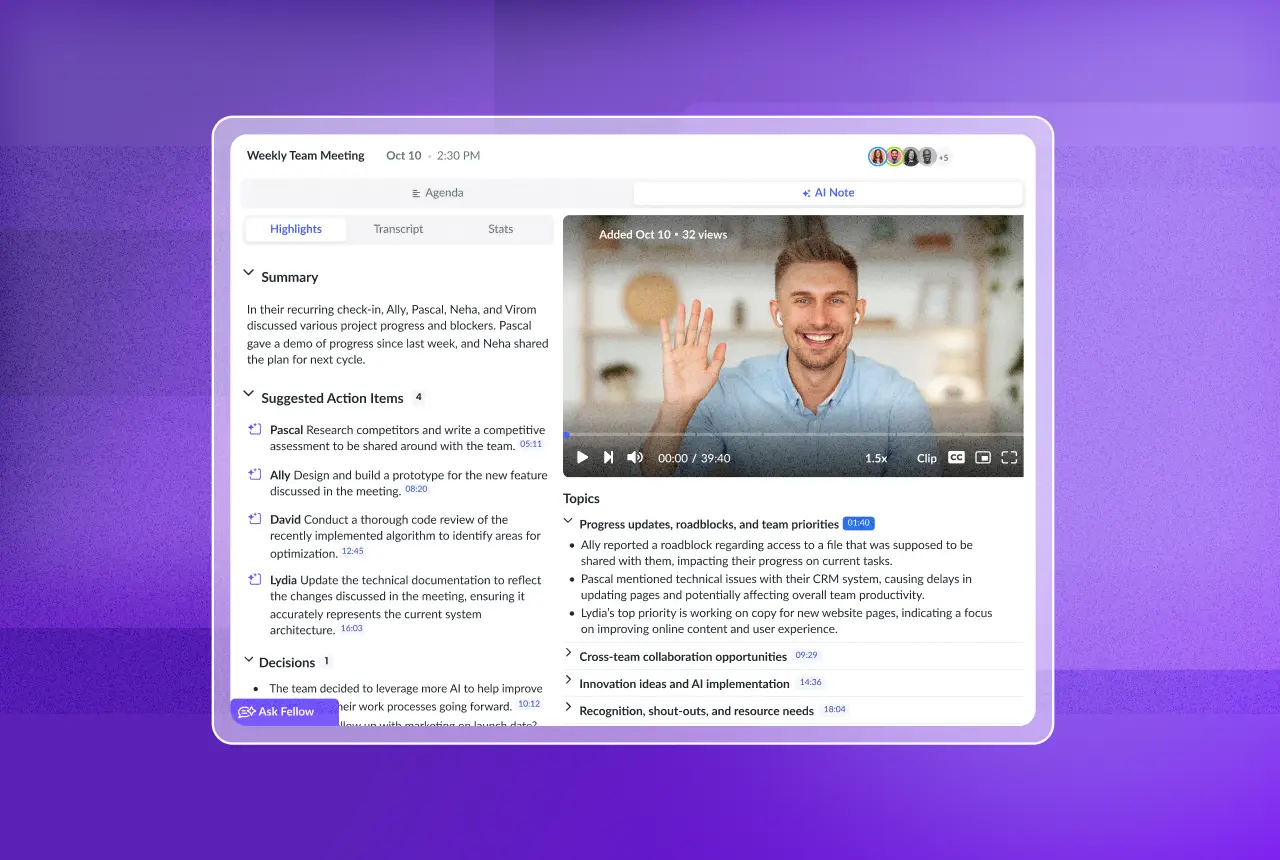
Fellow is a secure AI meeting assistant and notetaker that turns every meeting into shared, searchable intelligence. For marketing teams, this means campaign kickoffs, customer interviews, and cross-functional discussions become queryable knowledge rather than forgotten conversations.
Best for: Marketing teams and organizations that need accurate meeting records, customer insight capture, and cross-functional collaboration
Key features:
AI meeting notes with automatic action item extraction
Record, summarize, and transcribe meetings across Zoom, Google Meet, Microsoft Teams, in-person meetings, and Slack huddles
Botless recording option for meetings where visible bots aren't appropriate
"Ask Fellow" to query across all your meetings with natural language (e.g., "What feedback have customers given about our pricing?")
50+ integrations including Slack, HubSpot, Notion, Asana, and more
Central recording library with searchable transcripts
Enterprise-grade privacy and security (SOC 2 Type II, HIPAA compliant, no training on customer data)
Pricing: Free plan available. Paid plans start at $7/user/month.
Why it matters for marketers: Customer-facing calls, feedback sessions, and campaign discussions contain insights that typically disappear after the meeting ends. Fellow makes this intelligence searchable, letting marketing teams answer questions like "What objections did customers raise about our new feature?" or "What did we decide about the Q3 campaign timeline?" instantly.
If you're tired of losing context between meetings and want every customer conversation to become searchable intelligence, try Fellow free →
16. Gong
Gong provides conversation intelligence for revenue teams, analyzing sales calls to identify winning behaviors, deal risks, and customer sentiment patterns.
Best for: Sales-driven organizations tracking pipeline health and rep performance
Key features:
Call recording and transcription
Deal risk identification
Competitor mention tracking
Coaching insights for sales managers
Pricing: Custom pricing based on team size
Customer research and feedback analysis
Understanding customers at scale requires AI tools that can process thousands of feedback points and surface actionable patterns.
17. Qualtrics XM Discover
Qualtrics XM Discover uses AI to analyze customer feedback from surveys, support tickets, reviews, and conversations, providing comprehensive sentiment and trend analysis.
Best for: Enterprise teams managing customer experience across multiple touchpoints
Key features:
Text and voice analytics
Predictive analytics for customer needs
Multi-channel feedback aggregation
Customizable dashboards
Pricing: Enterprise pricing
18. SurveyMonkey Genius
SurveyMonkey's AI features help create better surveys and analyze responses faster, with new capabilities that convert documents into surveys and enable conversational data analysis.
Best for: Teams running primary research without survey expertise
Key features:
AI survey generation from documents
Conversational analytics ("What's the top complaint from enterprise users?")
Question suggestions and optimization
Response quality scoring
Pricing: Team plans from $25/user/month
19. Brandwatch
Brandwatch monitors brand mentions and consumer sentiment across 150+ million websites and social platforms, using AI to surface trends and potential issues before they escalate.
Best for: Global brands and agencies managing brand perception at scale
Key features:
Social listening across platforms
AI-powered trend detection
Conversational interface (Ask Iris) for insights
Podcast and audio content analysis
Pricing: Custom enterprise pricing
CRM and marketing automation
Enterprise marketing platforms now embed AI throughout the customer journey, from lead scoring to personalized content delivery.
20. HubSpot AI
HubSpot's AI features enhance its CRM and marketing hub with smart content suggestions, email personalization, and predictive analytics for lead scoring.
Best for: Marketers who live in their CRM and want AI-enhanced automation
Key features:
Smart content suggestions
AI email personalization
Campaign performance insights
Predictive lead scoring
Pricing: Marketing Hub Professional starts at $800/month
21. Salesforce Marketing Cloud with Einstein
Salesforce Einstein brings AI capabilities to Marketing Cloud, enabling predictive segmentation, automated journey optimization, and AI-powered content recommendations.
Best for: Enterprise B2B marketing teams on Salesforce
Key features:
Predictive audience segmentation
AI-powered journey optimization
Content recommendations
Integration with Sales Cloud for alignment
Pricing: Custom enterprise pricing
Email and outreach personalization
AI tools for email marketing have moved beyond basic A/B testing to real-time personalization and engagement prediction.
22. Smartwriter
Smartwriter uses AI to create personalized cold emails at scale, analyzing prospect data to generate messages that improve reply rates.
Best for: Marketers running outbound or account-based campaigns
Key features:
Personalized copy for LinkedIn, email, and cold outreach
Prospect research automation
Sentiment and interest tracking
Pricing: Plans start at $49/month
23. Lavender
Lavender provides real-time email coaching, scoring messages and suggesting improvements to increase response rates.
Best for: Sales and marketing teams focused on outbound email performance
Key features:
Real-time writing suggestions
Email engagement scoring
Personalization guidance
Gmail and Outlook integration
Pricing: Free basic plan. Paid plans from $27/month.
Workflow automation and integration
The most powerful AI marketing stacks connect specialized tools through automation platforms that orchestrate workflows across the entire stack.
24. Zapier
Zapier connects 8,000+ apps through automated workflows (Zaps), now enhanced with AI-powered suggestions and the ability to incorporate AI actions directly into automations.
Best for: Marketing teams eliminating manual work and connecting their tech stack
Key features:
8,000+ app integrations
Multi-step automation workflows
AI-powered Zap suggestions
AI actions within workflows
Pricing: Free for basic use. Paid plans from $19.99/month.
25. Gumloop
Gumloop is an emerging AI automation platform that lets teams connect any LLM (GPT-4, Claude, etc.) to internal tools and workflows without code, used by teams at Webflow, Instacart, and Shopify.
Best for: Teams wanting AI-native automation with multiple LLM options
Key features:
Connect any LLM to internal workflows
No-code automation builder
Premium LLM access included
Visual workflow design
Pricing: Free tier available with paid plans for higher usage
How do you build an AI marketing stack that actually works?
The most effective approach isn't adopting every tool on this list. It's selecting tools that serve distinct functions and connect through integration layers.
A practical starting stack for most marketing teams:
Content creation: Jasper or Blaze.ai for copywriting, Canva for design
Meeting intelligence: Fellow for capturing customer insights and team decisions
Automation: Zapier for connecting tools and automating workflows
Analytics: One tool for traditional metrics (HubSpot, Salesforce) plus Profound for AI visibility
Video: Synthesia or HeyGen for presenter-led content, depending on style needs
The key is ensuring each tool has a specific purpose and integrates with your workflow rather than creating another silo.
Frequently asked questions
What are AI marketing tools?
AI marketing tools use machine learning and large language models to automate or enhance marketing tasks like content creation, customer research, personalization, and analytics. These tools range from specialized platforms (AI meeting assistants, video generators, SEO tools) to comprehensive marketing automation systems with embedded AI capabilities.
What is Answer Engine Optimization (AEO)?
Answer Engine Optimization is the practice of optimizing content to appear in AI-generated answers from platforms like ChatGPT, Claude, Perplexity, and Google's AI Overviews. Tools like Profound help marketers track and improve their brand's visibility in these AI-powered search results, which are increasingly where consumers start product research.
How do I choose between AI marketing tools in the same category?
Evaluate tools based on your specific use case, integration requirements, and budget. For content tools, prioritize brand voice consistency. For automation tools, prioritize the depth of integrations with your existing stack. For meeting intelligence, consider whether you need enterprise security features like SOC 2 certification and whether the tool supports your meeting platforms (Zoom, Teams, Meet, Slack huddles).
Are AI marketing tools secure for enterprise use?
Security varies significantly by tool. Enterprise-grade AI marketing tools should offer SOC 2 Type II certification, GDPR and HIPAA compliance (where relevant), clear policies on data training, and permission-based access controls. Always verify security credentials before adopting tools that will process customer data or sensitive business information.
Can AI replace human marketers?
AI tools augment rather than replace marketing teams. They automate repetitive tasks (data analysis, content drafts, scheduling) and surface insights that would take humans much longer to find. However, strategic thinking, creative direction, brand positioning, and relationship building remain fundamentally human capabilities. The most effective marketing teams use AI to handle execution at scale while humans focus on strategy and creativity.
How do I measure ROI on AI marketing tools?
Track specific metrics tied to each tool's function: time saved per content piece, meeting context retrieved vs. lost, campaign velocity improvements, or AI visibility improvements. Most tools should either measurably reduce time-to-completion for specific tasks or measurably improve outcomes (engagement rates, conversion rates, customer insight capture).
Start where your work happens: in meetings
Your marketing team's most valuable insights often emerge in meetings: campaign planning sessions, customer feedback calls, cross-functional alignments, and strategy discussions. But without a system to capture and organize this intelligence, those insights disappear the moment the meeting ends.
Fellow turns every meeting into searchable, shareable intelligence. Instead of asking "What did we decide about the Q3 campaign?" and getting silence, you can search your meeting library or ask Fellow directly.
Ready to stop losing context between meetings? Try Fellow free →
Record, transcribe and summarize every meeting with the only AI meeting assistant built from the ground up with privacy and security in mind.